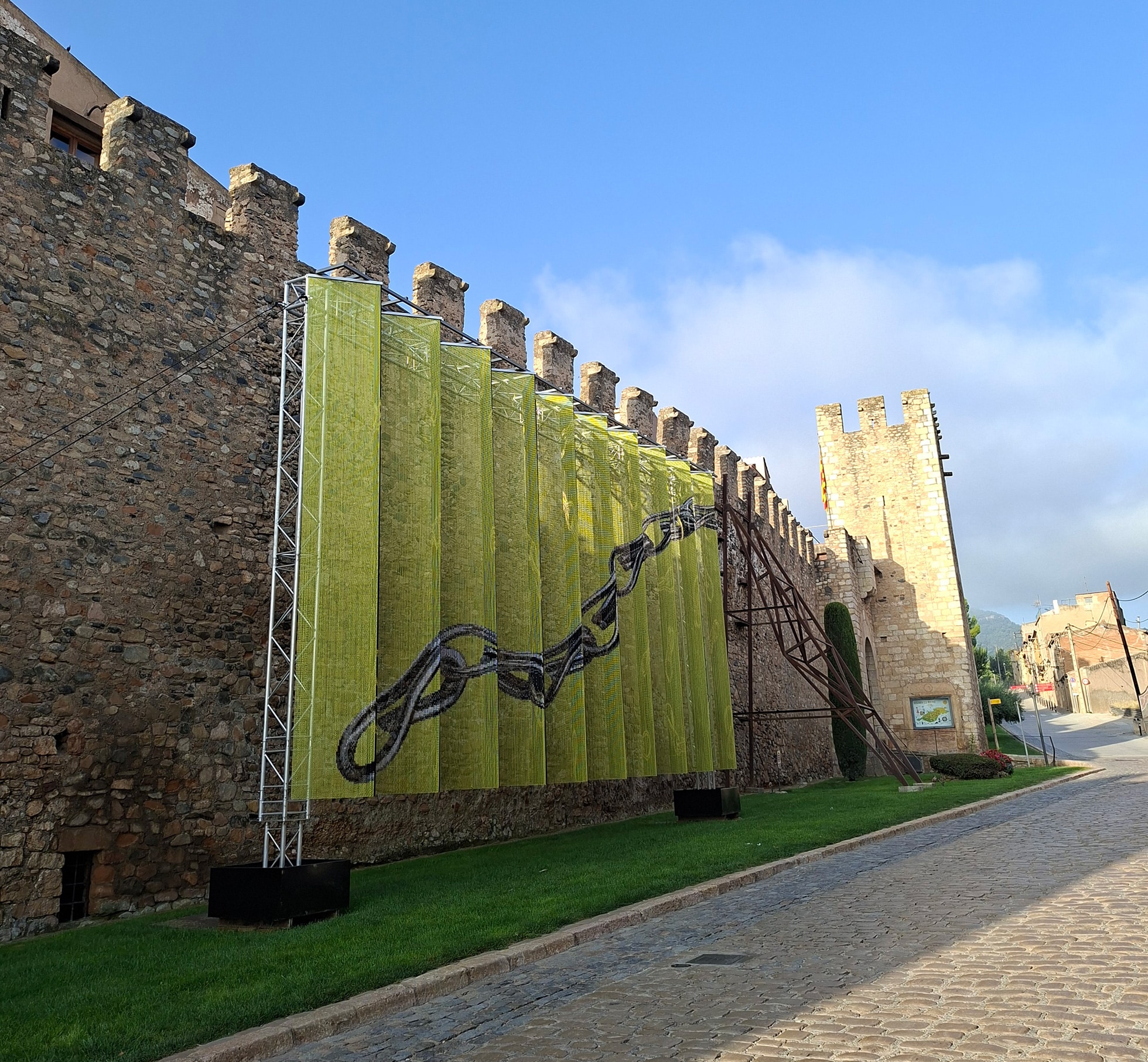
Some stories begin in the most unexpected ways.
Ours began in 1926, when our founder, Josep Maria Sans Amill, was studying in Barcelona. He bet his classmates that he could build a machine capable of joining chain links automatically. Shortly afterwards, the owner of a bakery in his hometown of Montblanc told him about the difficulty of keeping the shop door open during the summer without letting flies in.
From the meeting of those two circumstances came the first metal chain curtains: a simple solution that allowed fresh air to circulate while keeping insects out. Without realising it, that was the first link in a story that, one hundred years later, is still being written.
An Idea That Never Stopped Evolving
Those first chains, however, presented an unexpected challenge. Children in the town would remove the links to use them in their catapults, so Josep Maria Sans Amill developed a new chain with inseparable links that was far stronger and impossible to dismantle without tools. In 1932, this innovation was officially protected through the registration of the industrial design for the manufacture of a chain with inseparable links, a patent that would support the company’s growth for decades to come.
As time went on, the materials evolved too. In the 1950s, Josep Maria Sans Folch, the founder’s son, joined the company and led a new phase of modernisation. Iron gave way to the first aluminium chain and, in 1957, both this innovation and the process for anodising and colouring the chains were patented. Lighter, more versatile and available in a wide range of colours, the chains found new applications and reached new markets.

When Design Opened Up New Possibilities
The product continued to evolve over the following decades. In 1979, the Kriska links were introduced. More refined and elegant, they expanded the aesthetic possibilities of the chains and anticipated the design-led direction that would shape the company’s next chapter. In 1986, a new production facility was inaugurated on the outskirts of Montblanc, where the company’s headquarters and manufacturing centre remain today. Since 2002, all production has been concentrated at this site.
With the arrival of the new millennium, the third generation of the Sans family took over the company and embarked on a decisive new stage. Design became an essential part of the way the product was conceived, and the Kriskadecor brand was born. Gradually, aluminium chains moved beyond homes and shops to become part of architectural and interior design projects around the world. In 2008, the introduction of Snina, a smaller chain link, made it possible to create even more delicate and refined installations.
After years of international growth, Kriskadecor strengthened its presence in the United States in 2016 by opening a second office, first in Phoenix, Arizona, and later relocating to Miami, Florida, from where it coordinates its commercial activity across the Americas.
A Century Later
Today, one hundred years after that original bet, Josep Maria and Maties Sans continue to uphold the spirit of innovation first inspired by their grandfather. The materials, processes and projects have changed, but the curiosity to find new ways of doing things remains the same, as does the commitment to working alongside architects and designers to turn every idea into a solution.
Along the way, the company has also received distinctions such as the Special Mention for Design and Business at the 2024 Spanish National Innovation and Design Awards, recognising a journey built over the course of a century.
As Josep Maria Sans Amill used to say:
“There is nothing that can’t be done; you just have to find the way.”
Perhaps no better sentence explains why, one hundred years later, the story of Kriskadecor is still being written, one chain link at a time.